Services Old Nurses Uniform Surgical Services Old Dental Equipment Intensive Care Services Obstetric Services Central Sterilize Section Medical Equipment Section Radiology Section Hemodialysis Section Laboratory Section Pharmacy Section Public Health Section
Central Sterilize Section
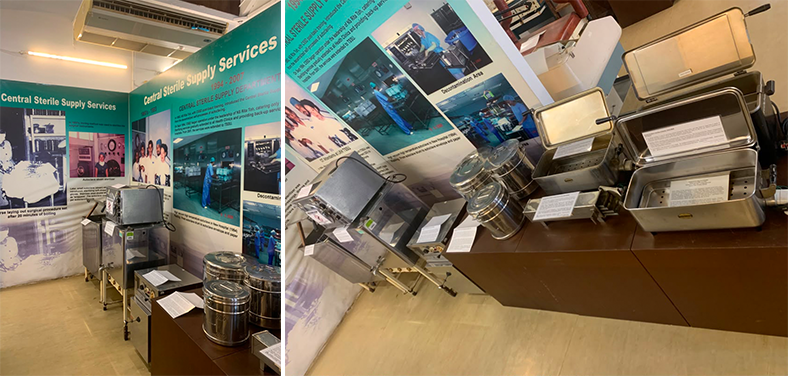
In the 1960s, after the relocation to the new Operating Theatre (OT), the Theatre Sterile Supply Unit (TSSU) was equipped with better and larger autoclaves to accommodate the increasing surgical workload. Major operating sets were sterilized using the autoclaving method, while fine catheters were sterilized using a formalin gas sterilizer. The day-to-day routine tasks of the TSSU were also carried out by OT attendants. During this period, autoclave drums were commonly used as packing containers for items undergoing sterilization. Certain surgical procedure sets from the wards, such as Lumbar Puncture (LP) sets and dressing materials, were sent to the TSSU for sterilization using these drums.
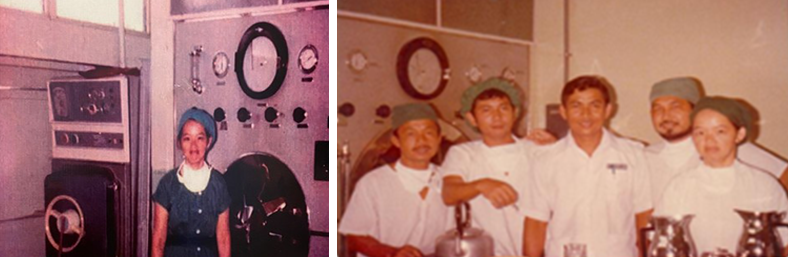
OT Attendants at LKH TSSU - In the 1960s, after moving to the new Operating Theatre (OT), the Theatre Sterile Supply Unit (TSSU) was equipped with two large steam autoclaves of the downward displacement (DD) type to meet the increasing demand for sterile surgical instruments. Autoclave drums were still in use during this period, while linen wrappers were gradually introduced. Fine catheters were sterilized using a formalin gas sterilizer. After 1984, two new high vacuum high temperature (HVHT) autoclaves were installed, one in the Operating Theatre and one in the Sterilizing Unit to replace the two old autoclaves. The boiling method of sterilization was gradually phased out and was completely discontinued in 1994.
Many more central sterilize apparatus and equipment can also be discovered throughout the museum, offering visitors further insight into the evolution of healthcare practices and medical history.
© Copyright 2011 THE LAU KING HOWE HOSPITAL MEMORIAL MUSEUM ASSOCIATION, SIBU. All Rights Reserved.